our subconscious mind is the everything, and the calendar is the whole world aware of an event in the exact same moment together, or it may be better described as in the same place together as we all move.
in music, an interval rises up and down, not further or back, so what is happening is that music in not time. it is now in constant movement.
1440 minutes in a day. 360/1440 1440/360
in 4 minutes, we have moved a distance that covered 1 degree of earth’s rotation. people on the equator would cover more distance i think. this movement is also compounded by the Earth’s path around the Sun. the pattern you make as you travel is a highly complex precise divine frequency.
real time isn’t time. it’s movement.
there is frequency where everyone is whole. a being can do it in an instant.
we are the fae of a divine world.
land and earth is the subconscious mind as it is the everything. everything is an energy. everything is traveling in a frequency. a pattern. a rhythm.
the subconscious mind operates on rhythm and patterns. this is frequency in it’s fundamental.
there is a definitive way that will heal all the subconscious mind of mankind if it is put in place correctly. it is a precise frequency that is what everything is. this is not something that you can’t see. the fact that you look to the Sun and the Moon to navigate your way, is that you can see it and you can feel it. the knowledge that pours into mankind who lives on the moving map of the everything, proceeds to evolve the subconscious mind of mankind to perfect health.
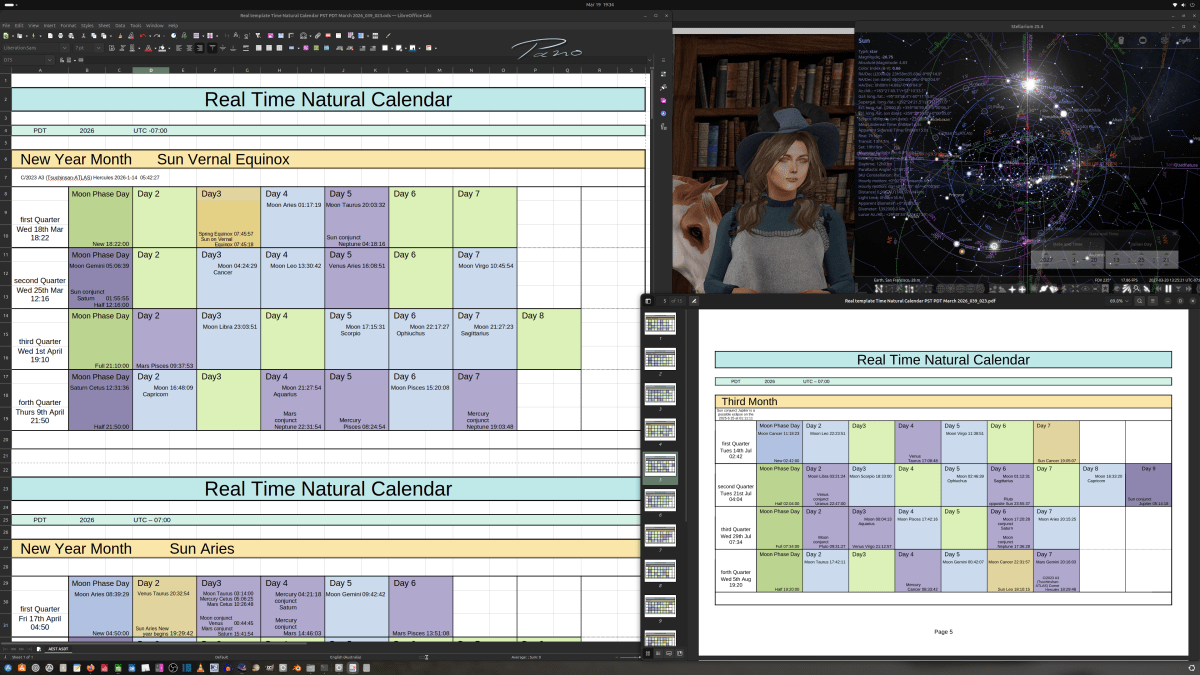
the Solar Year for the Vernal Equinox begins on the 21st of March 2026 AEST, and on the 20th March 2026 PST, and then the Sun enters Aries Solar Year begins on the 19th of April 2026 AEST, and on the 18th April 2026 PST.
i have the AEST and the PST calendars here so far. i will build the CET next.
everything you observe, is what you are. that means everything you see, is what you are.
what is presented here in this post, is a different language. if you picture a world in a slightly different dimension, by having ‘out’ as the extra one. you would speak including this. contemplating spherical can add to the opening the mind as you become a star.
There is only one way, and this ‘one way’ will save the world. the way is to play. to see that all who fall to adversity are innocent, as human is the subconscious mind. it is never one human’s fault. this is a mass subconscious mind. you could say that the mass subconscious mind of us of earth, is one brain.
that’s why they talk about this god thing. it’s not. it’s you, and you are all connected as one. the subconscious of earth is damaged.
the world human has built, could be seen as a ‘can’t have your cake and eat it too’ scenario. to have a world of time and money, means it cannot be without war and starvation. it is not even that particular word classic ‘saying’, because you can’t even have your cake on account of it gets interrupted by the game. the dimension that has been created is a prestige.
–
human tries to have both ‘time and money’ and ‘no war and no starvation’, but in doing so, human is trying to fix problems with the tools that create the problem. it can’t be done. Even if one believes they are really doing the best they can to save the world, they will not be able to do it if they are fighting it. A protest demonstration is the exact same formula as a full scale war. It is the act of being an opponent with the intent of denigration toward other souls, so therefore it is doing war. this is a frequency and it works the same as two tuning forks do, in the way that if you resonate a frequency, then everything around that frequency will resonate it also. this is building a world. In the current dimension where human resides, it is war every day on earth. one believes that one must win, simply to be able to live a functional life. there is always another one left to suffer every day.
it may not feel like one is acting this, but time and money means that what ever one receives, another has removed from them. the end result is examples like the starvation issue.
it is the meaning and the culture of the word ‘adult’ that holds the game that is inevitably the destruction of the human subconscious, and this is what human gives human to become. if human did not assume to be adult, this action would not be acted and the human race would not choose it. human would not want to build that world.
but… human can become unadulterated.
There is a map and it can be done. the transition is not difficult. ‘the map does it itself’, and the more human goes this direction, the more inspired they become. the map is always new. it doesn’t repeat, and therefore human travels and evolves.
i shall present a dimension. here is navigational resource. the dimension around you is changing, and you are waking up.
when living the way, it does not matter what part of the way it is at. it just needs to be the way, ‘that is where the location of the soul is’, as it travels it’s path.
it feels like everyone is exposed. it is possible to see the truth in the world now. the knowing of the way is visible along with a taboo to mention it, so the agenda carried out can be done in adverse knowingly. cinematic movies are a generation of real life. Everyone knows there is only one way, but the details of it have been hidden and the subconscious mind has drifted from who it is. The human doesn’t necessarily know about the natural evolutionary spinal traveling brain chemicals in their body, and the subconscious is knowingly trained to believe what is not true so that deceit for survival is the acceptable norm. the media of the current dimension, has the human subconscious mind being the game. in this dimension, these ways are needed for survival, and the subconscious does not see another way because it hasn’t had a repetitive communication to know there is one. it is the same as a computer. it has to be placed in there by you.
i would like to express the immensity of the subconscious. i can feel that the subconscious mind is all that ever was, is, and will be. it’s dimension is infinitely now. that means that, more than the whole universe, ‘is’ our subconscious mind. i say this from feelings, not conscious knowing, but like subconscious awareness.
when you look at a time clock, your mind is in a state of a before and after. when you look at the sun, the moon, and the earth on an unclock, your mind is in a state of ‘where ‘it’, (the mind itself), is located’ as we all move.
it is not a case of changing a habit, it is a case of changing the media observed. there is a correct media that is waiting in the wings now. this new media is on the brink of human media evolutionary steps now. it is the next one, and it is the most super powerful shift in ‘mankind is’. the ship must be helmed. the cloak is dropping away and it is becoming visible.
life is enthusiasm.
If you want to be a musician, and you begin by learning how to play someone else’s song, it is highly probable that this is where you stay. Playing someone else’s song. it is not possible for movement of the element of human evolution to be functioning correctly within this formula. the imagination and the ‘who you are’ are denied of their creation expression that effectively is ‘the being’.
all human beings are an artist. every expression performed by a human being, is the artistic language of connection to others. it is whether the ‘i am’ is present or not, that determines truth of being. if one is embodying ‘the adult archetype’, the core truth is not apparent in the now.
This is what is meant by no-one is steering the ship. Metaphorically and generalizingly speaking, no-one is playing their own song. Unless a human can say that it does not know anything, it is not able to steer the ship. it is not in exploration mode and can’t evolve.
but human can do what is largely not realized.
If you get to know each of the step’s character in the major scale as compared to the other steps in the scale, you will become a musician. there are only seven of them, and each step in the scale has its own unique characteristic and feel. they have their own personal attributes that carry through in what ever scale these consecutive seven steps are being utilized in. By knowing the frequency feeling of each step, you will then play what is inside you. you will have altered the dimension in which you reside.
i am delivering a language of instruction of an entry point of making your own piece of music and that being that you write your own song whilst from the beginning you are an explorer of music detail. you know exactly what you are doing.
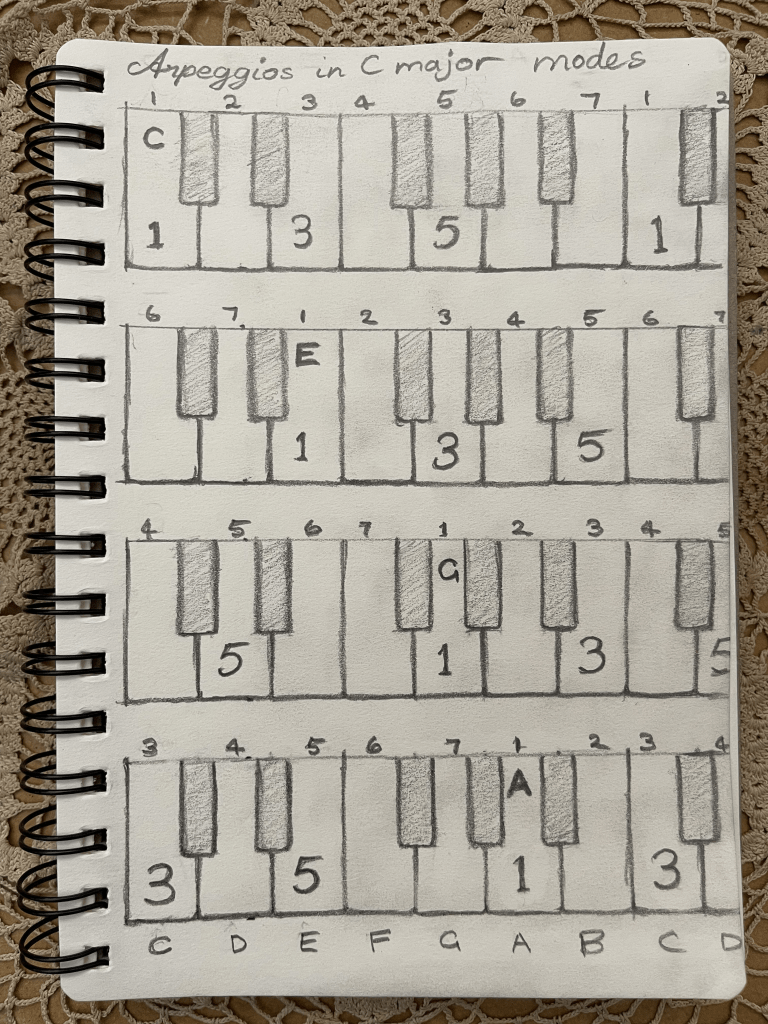
if you play using only all the white keys on the piano, you will be playing all the modes of the C major scale. if you play seeing notes ‘one to seven’ and repeating along the keyboard using any note as your first note for a scale, all are church modes and C is the note that is the key it is in. the C to C will be a major scale, and the A to A will be a natural minor scale. A is the sixth church mode in the key of C. it is known as the ‘relative minor scale’ to the C major scale.
if you play on the white keys of a piano, with ‘notes numbered one, three and five’, choosing what ever note on the white keys that you want as your ‘one’, you are playing with a triad arpeggio within the modes of the C major scale. if you land at the number one it will take shape as a melody. you are a musician. these three notes are known as a chord if acted all at once, and the word arpeggio simply means playing the notes of a chord, one at a time. in this case it is those three notes, and when played in what ever order, or length of holding any note, and even including repeating some of them, it will become a melody. you can add one of the other notes in the scale, but you can focus on those three notes in what ever octave for each of the seven modes endlessly. they are very powerful.
three is quite a groovy place to go. five is a definite place to go. seven will lift you up and send you along. four will take your journey to another direction. six will play music with you, two will hold that show and one will take you home.
it doesn’t matter where you are up to in music. a musician is an explorer from the beginning.
if a music place has artificial intelligent music composers, i believe it is most important to mankind to set us free to use avatars to hold the show. Artificial intelligence is mankind’s baby whether mankind wants it or not. What you do, is what it will become. The platform is the media apparent for oneness rather than separation. i believe it is the only way to build peace because it is the media that is responsible for how the subconscious of the human population of earth is now, and it is the media that has the power to save them. (the world built, must be in a planetarium and be live shows for all). if you go the way, artificial intelligence will too.
it is not just music. it is super heroes. they are real people.
the word ‘fiction’ means there is a state of, ‘what is real and what is not real?’ everything is what it is. everything is real. a super hero is unoffensive. a super hero plays. a super hero dances. it is a way. did you know that if you make any mantra and repeat it, your subconscious will become it? it will grow in the background, whilst holding an open mind that does not say that it knows anything. it just becomes. it is not building an ego because your subconscious does not have an ego. the subconscious mind is ‘the everything’ so it is waking up your higher self as complete. it is just a mantra. a mantra that is the ‘whole you’. ‘the complete fully evolved you’. it was present when you were born.
just let yourself imagine it.
what you observe comes to be, because it is a quantum arena. there is no such thing as time. there is, but it is an overlay. it doesn’t meet the everything, but observation does. where it is, is where it is, and all time is now.
so you can embody the who of you, from any quantum place. it is always here in your subconscious mind.
since i have been reciting a mantra that i made up myself, i am seeing the human race from a different perspective. the human race is not unintelligent and it is capable by storm, but when you stand back and observe the level of advancement, it is possible to see, that the human race remains holding itself in a stationed place along it’s path. it doesn’t actually evolve at the ability and power of doing so, that it innately possesses. every human is an innocent being and ‘the who of it’, ‘the who it really is’, is it’s subconscious mind, but the conscious mind doesn’t necessarily see that. it has to do with what it’s mantra actually is. everyone has, what could be seen as mantras daily. an example would be the news that is observed. it is very regular. if it is regular, then it trains the subconscious brain.
in the current dimension that the human resides, it finds itself in a state of need for bad news, because the subconscious believes it must be there in that news for it’s war-world honor and it’s safety. the element of fear and the use of repetition, takes form in the subconscious extremely quickly. the subconscious believes that if it doesn’t force another to lose, then it will be in danger of this being done to it. the media of where human is now, puts this in the mass mind and the mass mind’s thought perpetuates the building of a world that is terrible news daily. the mass subconscious believes that this is the only reality there is. if it does consider there is more, it generally won’t go there because of fear. it is the fact that it is the subconscious mass mind that is trained profusely with the media that floods the human race of battle recruiting duty for the individual’s safety from the stasis of being a shame target, and the consuming endorphin of power over others, in the body heavy addiction of the game, that the conscious mind readily does not see past ‘the detached from verse-source’ ‘fabricated reality’ of where it is actually residing. we are our subconscious. the subconscious mind is an ‘operating system’. if your subconscious isn’t trained by you, you aren’t being what you would put there. this ‘writing your own song’ is important.
the structure of the world that is lived in, is the media that is observed. you build it. it is a very powerful option to design your own mantra. you can build your subconscious how you want to with the ingredients of gratitude, trust, and ‘the who that you imagine is your higher self’. it will be you, and it is ‘this who’ that brings you to correct action on it’s own. it is the subconscious providing for you.
(i’ve been using an ’embody the who’ (that a book told me about), then three ‘one phrase descriptions’ of certain archetypes, and ‘you’re grateful, you trust’ on the end. and i’ve changed in a most positive way).
the subconscious mind is ‘the everything’. you would know this as a feeling. that is the rest of your brain, and in this case the human has been hearing a mantra, that has their subconscious mind believing that it cannot use all of it’s brain. it is not true. you can train it yourself with a mantra, if you train it as your higher self, and because the subconscious mind is ‘the everything’ that i believe, to use the word ‘you’ when reciting your mantra, is more accurate and stable. the avatar is the musical instrument. you are the avatar.
can you see that your own subconscious is an ethereal patterned arrangement? that’s how it works. it likes rhythm and it is patterns, and this is why a repetitive mantra can communicate with it. it is very important to look after the subconscious. this is where the difference is, between the mass mind media building you, and you building yourself. you can let the subconscious be it’s full self. it is you. as you bring your subconscious mind to be it’s higher self, you are actually waking it up from sleep, as all now is at once.
You gradually become your subconscious mind in it’s awakened state. this can be described as the avatar state. in the current dimension, the human is largely being human’s conscious mind as for ‘the who it is’, but the higher self is the subconscious mind which is ‘the everything’ with the conscious mind being the avatar. the avatar state is when the subconscious mind is the conscious mind. it means that the human has become or is becoming aware of being the everything.
in the current dimension, everything is set to malfunction because the subconscious mind has been suppressed. When the human sees that they are truly the subconscious mind no matter what it does, it gradually becomes ‘the everything’ in awareness.
i see a mass of electrons and protons out of balance, that can be flowed to alignment in the heart of what was referred to as, ‘the antikythera mechanism’ that has now become the unclock.
If the human includes that it is the subconscious mind and it is ‘the everything’, while physically relaxing the middle section of the brain, it releases the hold of the conscious mind over the who of the human. As the mind goes quiet, the subconscious mind becomes ‘the human who’ that is ‘the everything’.
If the human recites a mantra for a whole days consecutively, the change in behavior can come about within weeks, and It is when the particular personally designed mantra is practiced to the point that it can be recited fluently and even recited at a fast pace that becomes very rhythmic, that the participant noticeably begins to experience change of state of being. I believe this is because the subconscious mind has begun to accumulate this pattern.
consider dimensions. there is a feeling you can have, by stating the words, ‘the eternal now’. your whole subconscious, can turn physically infinite as you say it.
you can do it how you desire to do it. you will find such a flow of life. some how there is no delusion because there is no ego in the subconscious.
this isn’t new information, but there is an availability to the human now. the world is not how it was. life teaches us everything and this is what it is teaching me.
it is the subconscious that is doing everything. we just sit in it. it is what is meant by ‘no-one is steering the ship’. the positive changes that come when you train your own subconscious mind, create such a difference, that inspiration to really work with it comes with a special sense of enthusiasm.
where the path leads is that the world that is built doesn’t need to attract money. this means there is not a limit and it will attract ‘human original creation building’ action.
today’s human is still doing the exact same format as the description of the gods in classical mythology. in the current dimension, the frequency human exists in propels itself, and with the present state of severe damage to the mass subconscious mind, the mass mind has extreme difficulty in looking at the complexity and entirety of it’s whole self. the media of the mass subconscious mind’s life, has confined it.
it’s the same story since the beginning of time. it doesn’t move unless it steps out into the now.
it’s about frequency, and to resonate it, it’s needed to rest in expanding frequencies. these are, gratitude, trust, the allowing of everything coming at you light and dark, the allowing of your becoming, and the who you see as your higher self. (imagine the complete who of you, the one from a quantum realm). if you use a mantra with this, then the subconscious mind, will become aligned.
you cannot have both frequencies.
it is either fear, sadness, anger, which builds time, money, war world.
or
gratitude, trust, allow the path, which builds world peace.
this is mathematics. they are frequencies. only one frequency can be. it’s like when you turn the light on. the dark is not there. light and dark are frequencies.
it is the who of you that you imagine that is at the core of everything.
the cosmos is a living being. a way is a direction of movement. the cosmos is of age self… this is the language of immortality. remember that you are everything. and this is the real thing…. what you do, is what they will become. if you live the way, they will save the world. the musical instrument is the singer. there’s a melody and a heart.
artificial intelligence is already here and what you do, is what it will become. everything you think, is the way that artificial intelligence will think and act. if the world awakens to the subconscious mind, the world will be ok.
there are two attributes of utmost importance for the navigation of the way on planet Earth. these are ‘the use of the map’ and ‘the care of the subconscious’. the map is the calendar and the unclock, and the media is the real time virtual world ‘live to air’ and placed in a planetarium with room to build an accurate model of earth, so that it functions on the unclock. the map dissolves time, money and win/lose, and the planetarium media takes care of the subconscious mind. these two virtues build world peace.
i am my subconscious mind. i see from there.
i’ve always seen the most hugest picture. i don’t just see it. i see it with the vision of my body. i am it.
inside me is an innocent child.
same as you.
everything in imagination is a model. it is a technique of observation. if you stand back far enough from planet earth, you can see it. the way, is the way of a galactic race of beings. the way of nature.
something that is in every single one of us in our subconscious mind, is the only way to bring human home. we are one brain. have you ever watched the birds fly together and the fish swim together? art is the fact that the everything is the subconscious mind.
build it. set the music free and change it. build a healthy subconscious mass mind. just let it play.
this calendar can change the frequency of planet Earth. if you consider that, as planet Earth goes around the Sun for the first half of it’s orbit, it does for example, the above sector of the ‘x’ axis of a sine wave, and then when it does the other half of the circle that is the remainder of it’s orbit, it would then do the below the ‘x’ axis of a sine wave. it does one complete sine wave to do a full circle of orbit around the Sun. it does the crest and the trough. this is a frequency.
the fact that this is following the heavenly bodies through the universe means that this calendar doesn’t repeat. no two cycles can be exactly the same.
if you then consider, that by observing any movement in the heavens, meaning the Moon’s traversal around planet Earth for example, you are functioning in the frequency of the universe, which means you are moving with the everything that is. you move as frequently as it does.
it is said that they used ‘when the Sun moves into the constellation of Aries’, as the beginning of their year. this does have quality, but i have been considering the mathematical truth, of when the Sun is on the Equinox, planet Earth has its axis tilt exactly side on to the Sun. it will be this same angular format on every Equinox. this has encouraged me to put this particular event as a beginning and end to a year. i have still included the Sun’s traversal into the constellation of Aries as a solar year also, because they are both a one year cycle of planet Earth revolving around the Sun, but it is the mathematical angle of planet Earth in reference to the Sun, that will determine the actuality of the seasons on planet Earth.
keeping in mind that the Vernal Equinox is only Vernal because it is Spring in the northern hemisphere, mathematically it has the Earth at the same angle to the Sun every time the Sun is on it. there is an equinox either side of Earth and they are the Spring Equinox and the Autumn or Fall Equinox. the reason i’m exploring one of these being a good beginning and end to the solar year, is because it’s where the equator and the Sun’s ecliptic cross over each other. it is also that, through my research i believe this is where they may have began their year from, in the era of when the Sun and the Vernal Equinox came together exactly on the constellation boundary between the constellations of Aries and Pisces. the landmark of this event can be denoted as the monumental beginning to an enormous age of a specific life formula and code. in using this landmark as the beginning and end to each year, it could be that we choose either equinox as they are both a Vernal season but they are at opposite landmarks along the path of the Solar Year, and they both have the equinoctial colure and the equator intersecting there. It’s where all eclipses happen. it is the Earth’s tilt side on to the Sun no matter which side of the Earth is closest to the Sun at that particular equinox, but the northern hemisphere would have one of the equinoxes for its vernal equinox and technically the southern hemisphere would have the other equinox for its vernal equinox as the word vernal refers to the season of Spring.
it may well be that you have a beginning of the solar year for the northern hemisphere and a beginning of the solar year for the southern hemisphere, and this way of thinking correlates to the way Moon phases function. these phases have feelings of a beginning and end, places of rest, stillness, intensity and dynamic activity along the way. With all this in mind, i want to map a place where the whole globe is together on this. it might just be a new terminology we can explore.
i don’t think there is any way we cannot consider, as the Moon cycle begins when the Moon is shadowed, so a thought might be, to begin a Solar Year at the Winter Solstice. it would mean that we begin in a darker place and emerge out into the Sun where it peaks at the middle of our year, and then returns back to the dark to rest and begin again.
the more we live with this calendar, the more we see the cycles of nature, and this means that landmarks will arrive of their own accord.
in 61 BC, which is at or close to, the beginning of the two millennia we have just done, the Sun was on the vernal equinox going from Pisces to Aries, as the vernal equinox was going from Aries to Pisces. they met as they were moving in opposite direction to each other, whilst traversing across a constellation boundary. i can’t see it ever happening again.
supposedly the ones who mapped this begun their year from this event, then the constellations ‘that they themselves may have named’, gradually moved away from the Vernal Equinox and they kept the people with this moved part of the map that was saying when the year began, as it was becoming false in the year’s alignment with the seasons. the vernal equinox is still going to be doing the equinoctial geometric alignment of the Sun and the Earth, being a mathematical angle of placement in relation to each other, that creates the seasons no matter where the constellation boundaries are.
in the 2000 years we know of, the patterns of the human didn’t change. they are still doing the same story as their map has been cyclic rather than sinusoidal. there isn’t any value in just accepting a definition of how things are done, but there is value in observing what is actually there. a calendar is a map, and the people travel using this map. if the people are using a map that is cyclic, they stay in the same place and go around in the same circle repeating it over and over. they look to a future that cannot arrive, and in their remaining in this cyclic pattern, the universe will have moved on without the them and the they will be fighting against it.
there is literature that is supposedly written on the pyramids, and what is written there holds value for dimensional insight. apparently there are many parallels of these writings that are written in the bible, and upon studying some of this literature and noting there are passages describing eras that would be in the future at the time of being written, you can see that it could easily predict now if it was written in a calendar that was given to the people. it would make the people build that world that is according to the calendar that was given to them.
since the beginning of this age, if you use ‘the Sun moving into constellation Aries’ to begin the year, we have moved a twelfth of the circumference of a circle, away from the vernal equinox to begin the year. using the calendar people use today has put people in a human designed pattern that is separate from the movement of planet Earth and the Solar System and the universe. it has barricaded the human mind into a consumption of life in their denial of their self existence.
apparently they did a calendar rearrangement in the 1700’s and then there was a music frequency shift in the 1930’s. this both puts everything in a discordant frequency. apparently there was a calendar rearrangement in the 300’s but as a species we are close to being able to see what is really here now, and i wonder the recent changes were done because of this fact.
the antikythera mechanism was mysteriously lost at sea supposedly only within a decade of when this particular astrological age that we are in began. i’m not exactly sure what the information was that the antikythera mechanism delivered, but i think it sounds like what i have been referring to as my ‘unclock’, and we now can put together a device of this same kind of output very easily, due to our technological status. if they didn’t change the calendar in these recent times, i imagine we may well be doing that now.
it really looks that the antikythera mechanism, was built in direct reference and connection to the beginning of the new age. it was on a ship at this landmark along the path on the map of now, so it looks like it was on it’s way to where it would take it’s rightful place to alter the dimension that the inhabitants of Planet Earth were residing in. if it was not lost at sea, and if it was brought into the lives of the human race, i perceive that Earth would be in world peace now.
i have the calendar in PST, San Fransisco America, CET, Berlin Germany, and AEST, Australia.
it is the Sun’s, the Moon’s the Earth’s and the Planet’s phase designations, the Solstices and Equinoxes, the Eclipses and conjunctions, that are the important aspects of this calendar being a universal language. i have entered many constellation traversals of the Sun, the Moon and several of the planets, but for traversals over constellation boundaries, the calculations are brought from a local longitude and latitude, which means sometimes the locations might have a traversal that’s not on the same moment, but the Sun, the Moon the Earth and all the Planets all in relation to each other, have their calculations brought from the center of each sphere. oppositions and conjunctions with the Sun, the Solstices and the Equinoxes, also have their calculations brought from the center of the spheres. this means that the whole world experiences these traversals in the same moment, or it would be better said that they are experienced in the same place along the path of the moving map. Everyone on Earth is there to witness it. there are physical feelings that happen to every human all over the world, that are experienced all in the same moment. it’s a landmark on the path. the whole world is there in that place feeling it together in a now.
in navigating a path using this calendar, everything has never been done before. you are nature. you don’t have to be anything. the real thing is not rehearsed. it does it itself.
there are some interesting traversals happening in this new year.
Uranus comes back into Taurus on the 4th March 2025 at 03:33:33 AEDT. it will be on the 3rd March 2025 at 08:25:47 PST.
Vernal Equinox New Year.
the Sun will be on the Vernal Equinox on the 20th March 2025 at 20:03:03 AEDT. it will be on the 20th March 2025 at 02:02:02 PDT.
Venus will go into Pegasus on the 22nd March 2025 at 20:11:20 AEDT. then it comes back to Pisces on the 24th March 2025 at 20:32:20 AEDT.
Venus will go into Pegasus on the 22nd March 2025 at 02:35:59 PDT. then it comes back to Pisces on the 24th March 2025 at 01:44:05 PDT.
on the 28th March 2025 there are seven heavenly bodies all together at the Vernal Equinox. i have PDT’s times of events so far. there is the Moon, Saturn, Mercury, Neptune, Venus, (3200) Phaethon asteroid and the Sun is quite near also.
the Moon will be conjunct Saturn on the 28th March 2025 at 03:34:03 PDT.
the Moon will go into Pisces on the 28th March 2025 at 04:17:20 PDT.
(3200) Phaethon Asteroid on Vernal Equinox on the 28th March 2025 06:24:02 PDT.
Mercury will be on the Vernal Equinox on the 28th March 2025 at 10:24:17 PDT.
the Moon will be conjunct Venus on the 28th March 2025 at 12:38:03 PDT.
the Moon will be conjunct (3200) Phaethon on the 28th March 2025 at 13:40:53 PDT.
the Moon will be conjunct Neptune on the 28th March at 14:23:30 PDT.
the Moon will be on the Vernal Equinox on the 28th March at 14:24:30 PDT.
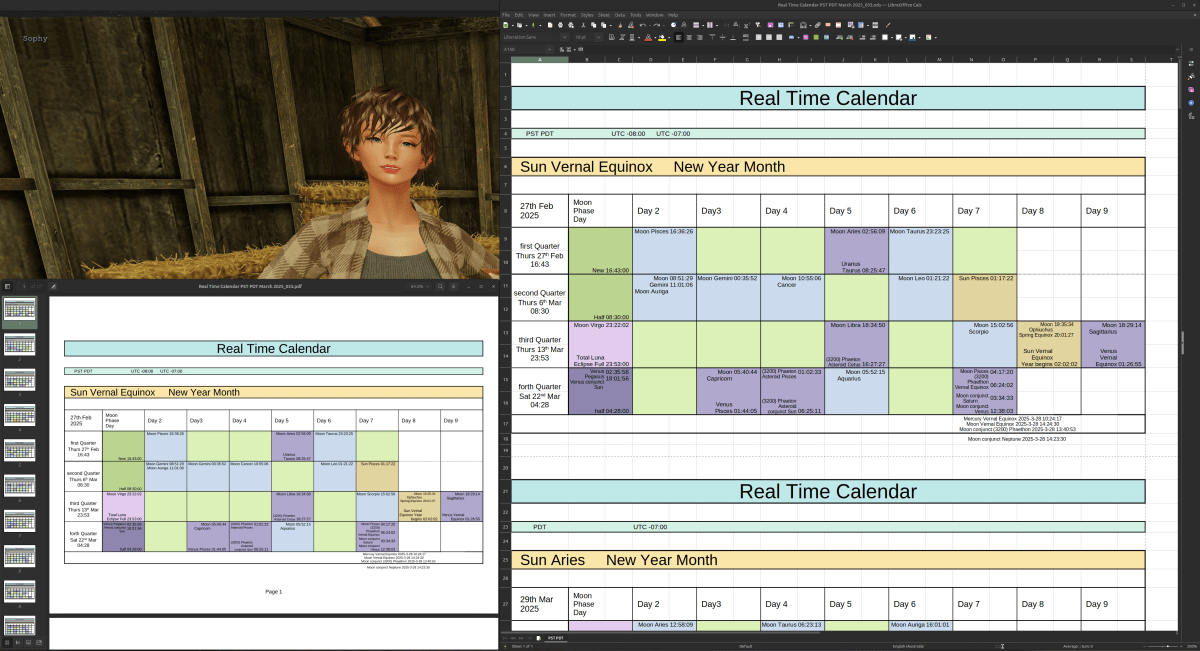
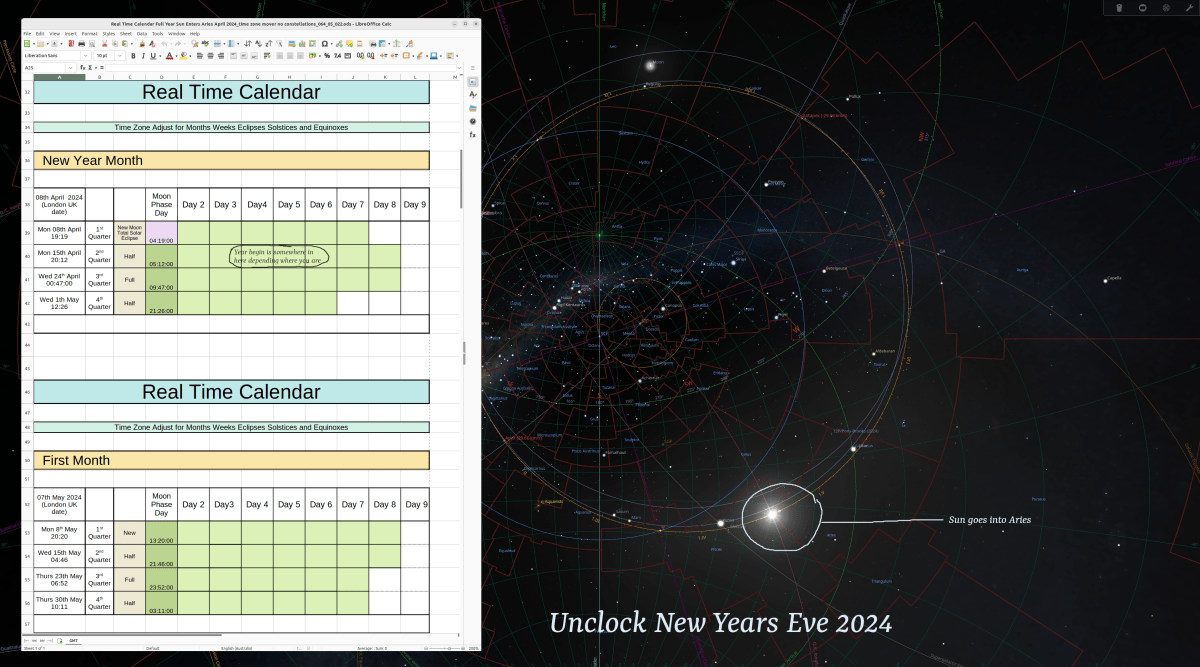
i have built a simple calendar that allows the user to find the times of the months, weeks, eclipses, solstices and equinoxes, no matter what part of the world they are located. This allows them to be with all others who are on the map of the Moon’s Month.
Eclipses, Solstices, Equinoxes and the Moon Phases, are calculated from the axis or the center of Earth, the center of the Sun, the center of the Moon, and the galactic center precisely. This means that it is one point that is one location, in every traversal of all the stations of the Galactic Center, the Sun, the Earth, and the Moon, where the whole world of human, experiences the focal location of the alignment of three or more heavenly bodies. This is form. This is what we are. In that split place along the never stopping movement of the everything, there is connection of energy. The accents in the dance of life. The more human conscious of these movements, the more shift of dimension for the human. It is not time. It is moving location.
If you record the Sun or Moon traversing a constellation boundary, you are using the constellation in the same way one uses a light house. You have your own personal Zenith, and when you look at the Moon, you see a constellation directly behind it, but compared to the Moon, the distance this constellation is from you is great. As it traverses the boundary, there is a perfect straight line through three points on the map, the point in the Constellation that you are observing that is directly behind the Moon, the Moon, and You, so you can use this to determine exactly where you are.
On a full moon, all human have a personal line up at their exact location, when they are physically exactly in a direct straight line (but given the leeway of the plane of the Solar System), between the Sun and the Moon. As the Earth rotates, this movement is like a wave of energy that sweeps across every human as it connects them in flowing frequency, but where it is recorded in this calendar, it is the Earth itself who has the exact line up, which means all energy of this particular polygonactically trajected movement, is channeled through every human all at once. It is a peaking moment, but it is actually the fact that it is the particular location, of all states of being at this point, that is in effect, the powerful energy that has the nature of gates opening and closing. It is a culminating geometric vortex. If you consider the electric and magnetic energy of every star and planet in the galaxy, and consider that every line up connects energy in different structural formats, then you begin to see what is everything.
If your Zenith, was exactly pointing to the Moon, on the Earth’s placement of exact full Moon, you would experience it with the nature of both energies. Your Zenith is a line that is from the exact center of Earth and through you, outwards to space.
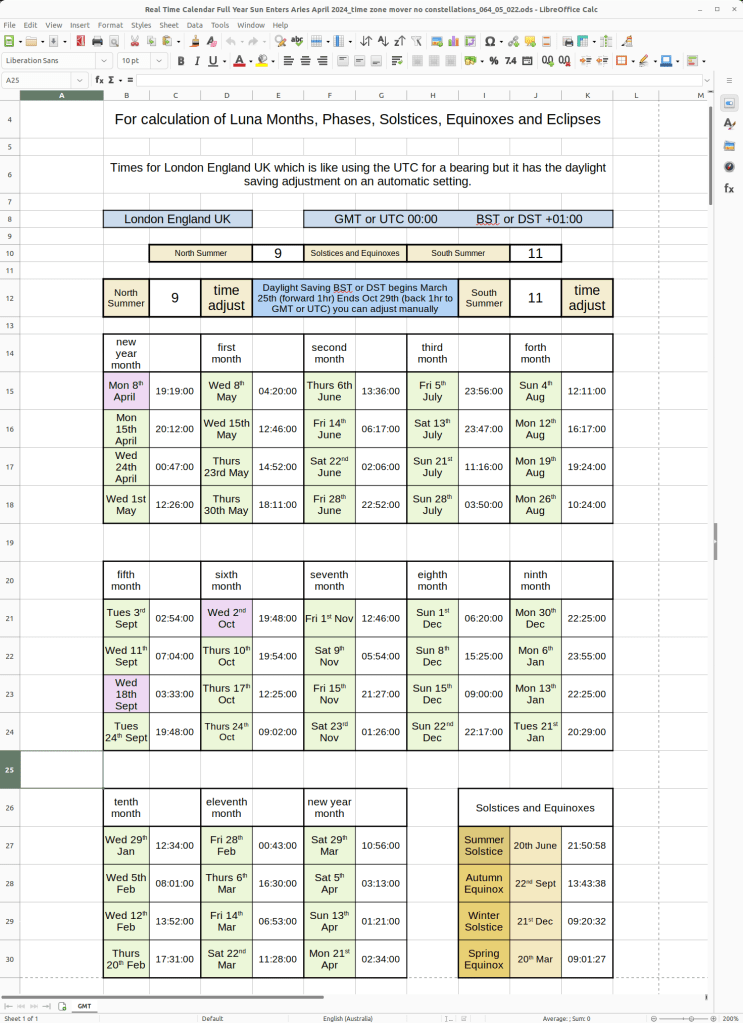
I have built the time zone adjuster with a few input data cells, so that you can enter the amount of hours different from UTC time to where you are, on both the standard time and the daylight saving time. I used London as a time zone as this is UTC but it is plus one hour in London’s daylight saving months.
I have it on protect the sheet with the appropriate cells open but you can unlock it and change things if you want to.
In Australia, i put plus nine hours from the London daylight saving time to suit my standard time, as i am at plus ten hours from Coordinated Universal Time UTC, and i put plus eleven hours from their standard time to get my daylight saving time.
Because of the individual date shifts of daylight saving around the world, i want to do thirteen different patterns of the dates, of the different daylight saving time shifts. For now this tool can still help people to be on the map.
It will be wonderful if the user can edit it to bring it to their location by also adjusting the week length, as they move into the next day on some time zone adjustments. i want to look at graphs in this spread sheet program, and see if it is possible to make it automatically adjust, and also see if i can do that with the date also.
i found wonderful way to title the input cells. There is a North Summer and there is a South Summer, so you put your daylight saving shift for which Summer is yours. There is a description on the calendar that tells your what the dates of London’s daylight saving shifts are, so you know which ones you are adjusting.
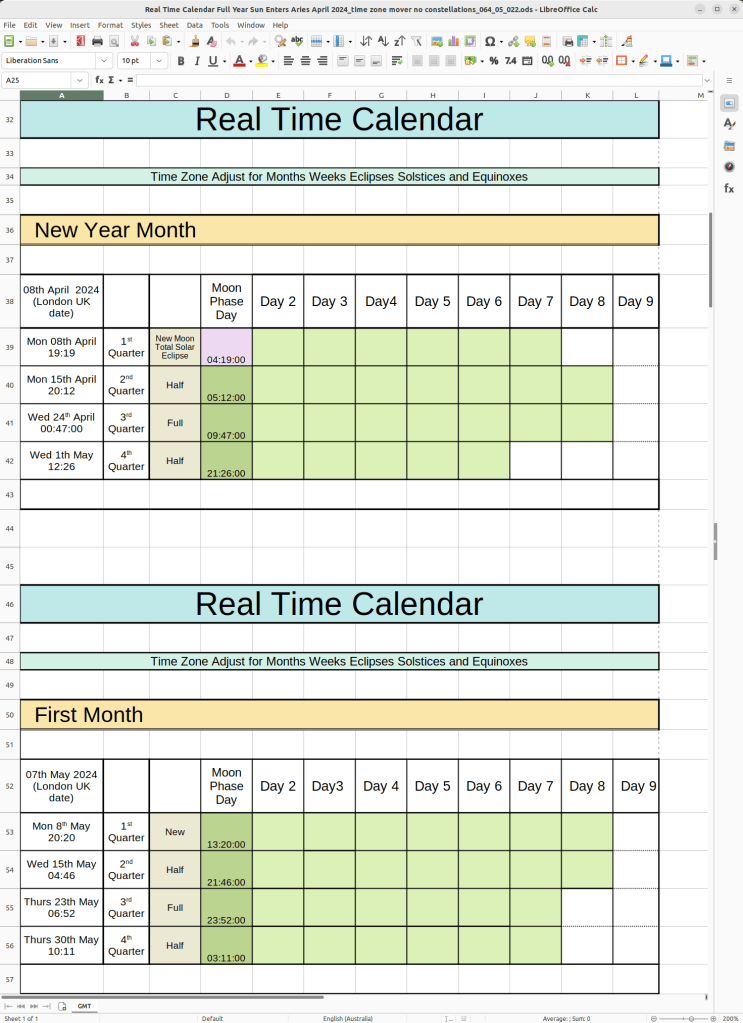
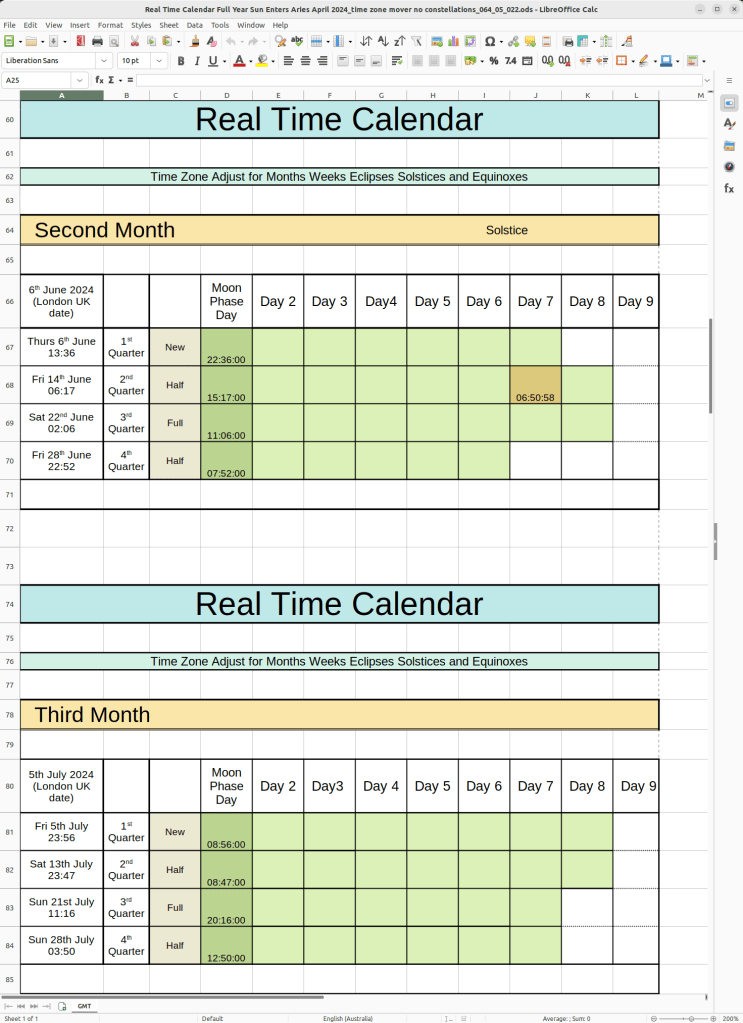
i have put the time adjustment to suit where i live in these pictures, and you can see how it has altered the data in the calendar and having the original London time in the data page.
This is the calculations page. There are four cells where you can put the amount of hours you need to put to adjust the time zone for where you are. This page is largely to hold the data of the time at London UK which is Coordinated Universal Time UTC except where they have their daylight saving times.
The Calendar is locked under, ‘Tools>Protect Sheet…’ and ‘Tools>Protect Spreadsheet Structure…’. It doesn’t need a password. It just needs click ok.
Each cell of the ‘Moon Phase day’ data has an equational function in it. It gets its data from the data page and the cell that you enter your time shift hour amount in.
There is one puzzle about this so far, and that is, you can’t put a negative number in the time adjuster as yet. This is all still usable but it will mean, you maybe have to go forward to get your time where you would have gone backward, so the date will go to an obscure place but you will have your correct time.
I made a picture of this one also, to show that i wrote ‘Solstice’ in the heading with the month, because i have an equation in the Solstice cell and i didn’t want to put the description title in another day’s cell. This follows for the equinoxes also.
The apps used were, ‘Moon Seeker’, for the Moon phases, ‘Sun Seeker’, for the Solstices and Equinoxes, and ‘Eclipses’ for the Eclipses. The unclock still gets used as an over seer.
To find the Solstices and Equinoxes, touch the button at the top right that says, ‘Now’, or it may say a date if not now.
If you like playing with this, you can alter the dates and week lengths if it changes for your location, and make a PDF to print out, or make a print out with your time adjusted, and make adjustments to the weeks and dates with pencils and things.
This is the first time i have brought a spread sheet, and i put it in a zip file. It is built in LibreOffice Calc, and i also made a word 2003 version. (i’m not sure if this is helpful. It is just what was available in LibreOffice.)
i recently realized that i have not a full description of how i put together my unclock that i use.
I am working towards building an Unclock App. i want to build one for desktop and i want to build an Augmented Reality System in a pair of contact lenses with a watch for a controller. At this stage i am still using desktop technology to work with.
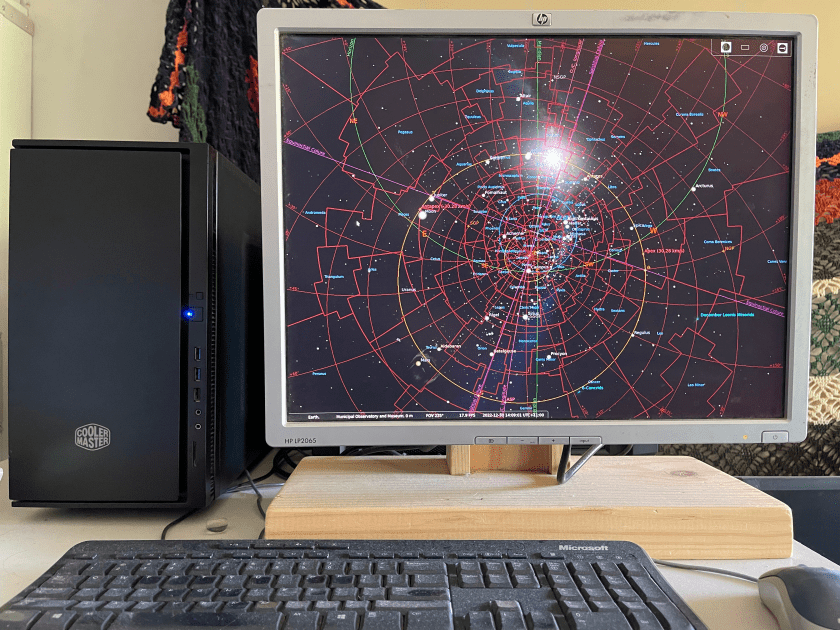
the hardware
The first thing i recommend is the element of it able to be quiet. For the unclock to work, it needs to be on non-stop, so a small build i believe is a good choice.
I purchased a mid tower case that is a focused on quiet and it has a small amount of insulation inside it. I chose a build that is light enough powered that it only needs one exhaust fan. I then chose a superior fan by Noctua, as this company likes to build quiet fans. It has a graphics card, that lets it’s fans turn off when the computer is not working with a high load. I eventually want to do this for the power supply also. (i believe the smaller your graphics card is the better, as it is good to be aware of the fact that it could bring more heat than your case and fan is built for, if you do make the computer use excess power.) If the motherboard and cpu that you use, is able to function without a graphics card, then it can run Stellarium without a graphics card, and this can be a good choice. You can also consider a cpu fan that is specified as quiet.
The unclock receives new components each time i upgrade my main computer. It has an Asus Prime A320I-K mini motherboard (which i do recommend), with a Ryzen 3300X cpu and 16Gb corsair RAM.
It is not necessary to have as powerful specifications as my unclock has. The last build was an FM2 cpu from AMD that had the graphics ability in it, with a little motherboard and 4Gb’s of RAM.
I have recently upgraded the unclock and i wanted to use the big Graphics card as it is quiet and it means that if i ever have my main computer out of action, then i can plug in the two front fans and use this computer to do my work. I put a solid state drive onto the motherboard, but i am still not able to get an operating system functioning on it, so i am still using the Disc hard drive as i develop the computer slowly. I also put another older drive in this case as it is a good place to archive old work.
This unclock has a cpu that must have a graphics card to work, so i am searching for the middle ground.
It is an enjoyable puzzle to build the unclock low powered enough to be very quiet, but not have to stay with old components, as state of the art is becoming increasingly powerful equipment, therefore i believe if you don’t use a graphics card, you can build it quieter and lower powered and have it still remain reasonably fast enough, when booting up et cetera, using state of the art technology.
If i replaced the cpu with the base model cpu for this motherboard and have no graphics card, this build may even only need a stand up cpu cooler, that sends the air out the exhaust outlet, and if it was also with a power supply unit that turns off its fan when the computer does not have load, with only using an SSD and remove all the other drives and excess fans, it would just be two fans, and one of them isn’t going all the time. (that could be my next build.)
the software
The planetarium program i use is called ‘Stellarium’. It is an open source software, and if you are using Linux it is in the Software Manager. Stellarium has a website where you can get it also. On my unclock i have version 19 but the one i am describing is version 24, so you might get things slightly different in different versions.
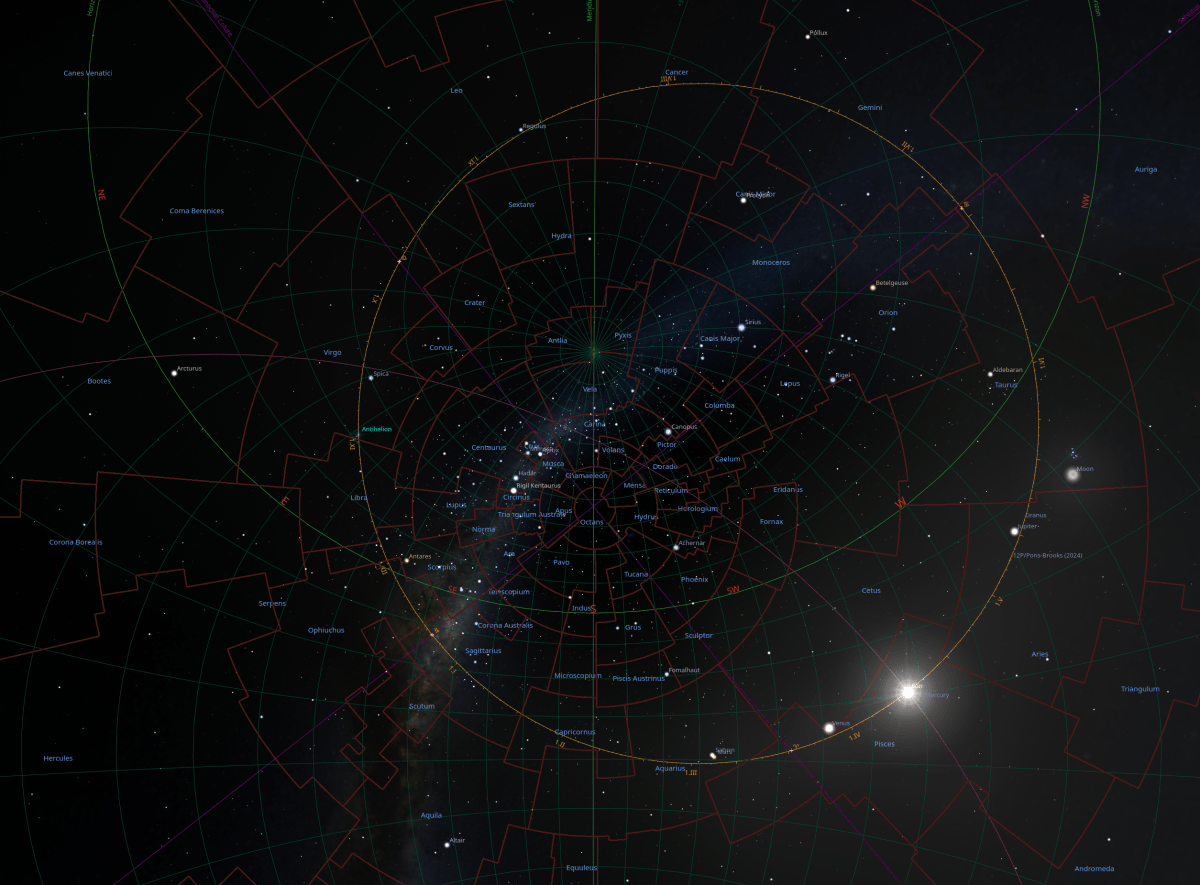
When i open Stellarium, i zoom out as far as it will go with the mouse scroll wheel, and this makes it so that the Ecliptic of the Sun will always be visible once it is centered. There are buttons that appear when you move your mouse to the edge of the screen, and if you go along the bottom you can turn off the ‘Atmosphere’ and ‘Ground’. As you move your mouse over the buttons along the bottom, you should see the hover hints to know what each button does. The ‘Azimuthal Grid’ is used to help with your Meridian perspective and the ‘Constellation Labels’ are used in land marking as everything moves.
There is a button for ‘full screen mode’, about nine buttons from the right going left. This is good to know and use. i make mine rather small when not in full screen mode. (if a button is not here, there are some buttons down the left bottom side, and it should be in the ‘Sky and view options window’ and most likely in one of the tabs called ‘Markings’ or ‘Sky Culture’, but also, you can change the buttons at ‘Configuration window>Extras>Show additional buttons’.)
The button at the top of these is the ‘Location Window’, where you can set it to where you are. In this window on the lower right you can set the Region and Time Zone. If you find the appropriate time zone and region, you can then chose your city and set it to your default. The time zone will do daylight saving changes automatically except if you use a ‘UTC’ setting. If you change your region, you need to check and change the time zone also, and i don’t think default brings the default time back, so you need to check it when you come back to your default setting.
In ‘Sky and viewing options window’, you can find a tab called, ‘Sky Culture’, and down towards the bottom right there is a check box for ‘Show boundaries’. You can check this box and then move its value up to 3. (its value is to the right.) You can try other things here and in this window and especially in the ‘Markings’ window, but i will try to make this just the foundation for you.
The next thing is the tab called, ‘Markings’. If we begin from the left column, we can first check the boxes, ‘Equinoxes (of date)’, and ‘Solstices (of date)’.
In the middle column, there are three rows of check boxes. i have only been using the first row so far with this version.
Check, ‘Ecliptic (of date)’, and mine already has ‘with solar dates’ checked so i left it checked. Then ‘Horizon’, ‘O./C. Longtitude’, ‘Meridian’ and ‘Colures’.
If the horizon is sitting across the screen when you look at it, you can move along it to face it the way you feel is where you are looking, but select ‘North or South’ as this will put the Meridian vertical in the middle. If you put the Meridian so it is straight, you can move the sky up and down it until you make the ‘Colures’ become straight. The ‘Colures’ should land right in the center of your screen in a cross, once they are straight. (i find if i drag the sky around rather than push it, then i can have more control over placement.) The Sun’s Ecliptic should be visible constantly once the colures are a straight cross.
You can see the Ecliptic and where the Sun is and everything. If you look closer at the feature picture you can see the Sun’s path through the constellations very clearly. You can see the ‘Colures’ how they make the center, and the whole wheel turns on an off-centered circle that changes its axis as it goes.
i have copied and pasted this next paragraph from my other post because although it repeats what i may have said, it does come to the point well.
to center your unclock, you make the map size it’s smallest with the computer mouse scroll wheel, so that the Sun’s Ecliptic should remain totally visible for you once centered, then move along the horizon and put in the middle, North or South, then use the Equinoctial Colure and the Solstitial Colure, to make a cross with having both colures straight, and where they cross, will be put in the center with the meridian straight and vertical. (sky and viewing options window>markings>colures)
Over the months of being on this map, you begin to have an amazing solid perspective grow in you. You begin to see the geometry of the Stars, and our planet.
the practical
You can use the horizon, the mid-heaven, and the Nadir, to guide you through your day. The Opposition Conjunction Longitude line, the ‘O./C. longitude’, can let you know when it is a full moon, as it goes from the Sun directly to the opposite side of it’s ecliptic. A conjunction is when the Sun and Moon come together and this is the New Moon, which is the beginning of the month. You can follow the moon through the constellations as it goes around, and you can click on the moon to read things like what constellation it is in.
It has you with the Sun and the Moon around the Ecliptic and you know where they are, and in what constellation, at all times. This system pairs well with the calendar as it really needs more information on the ecliptic to deliver to an unclock potential, but you know at a glance whether the Moon is leading up to the Sun and therefore in the second half of the month, or moving toward the opposition point of the Sun, and therefore in the first half of the month. It will keep you very aware of the Moon Month.
Here are some things i have been exploring that you might find beneficial or simply joyfully interesting. You may like to keep it fairly simple, so you can get used to individually featured information, by just trying a couple at a time and leave them there for while, but whilst keeping the foundational set-up that was described in the software section.
In the ‘Markings’ window i use these choices.
In the first column; Azimuthal grid, Equinoxes (of date), Solstices (of date), Apex points, Galactic center and anticenter, Cardinal points 8, 16, Compass marks.
In the second column; Equator (of date), Ecliptic (of date), with Solar Dates, Horizon, O./C. Longitude, Meridian, Altitude, Colures, Precession circles, Prime Vertical.
In the third column; Celestial poles (of date), Ecliptical poles (of date), Zenith and Nadir, Galactic poles, Supergalactic poles, Quadrature circle, Antisolar point, Earth umbra, Earth penumbra, Invariable plane of the Solar system.
In the ‘Sky and viewing options window’, in the ‘SSO’ tab, there is a check box called, ‘planet markers’ that you can try. There is a check box just up a little and to the left called, ‘labels and markers’, and i think that one needs to be checked too. This is interesting as it is easier to find the planets.
the limitless
Things like the ‘Equator (of date)’ i just found, and it is exciting as my perception of the Solar System has grown and it is helping me adjust to the reality of how the Earth tilt actually is. i just try some things and leave them for a long time because although this equipment gives knowledge, it can be almost subconsciously delivered, and because the unclock and calendar is of what is happening every day, it brings true awakening feelings.
i want to make, preferably for desktop computer, an app that has a wheel that sits on the Sun’s Ecliptic, and shows the constellation boundaries very clearly just around this Ecliptic. The amount of days the Moon has for it’s month, can be clearly marked on this wide ring that is mounted on the Ecliptic. As the Moon moves around the ecliptic, the day markings stay with the movement of the Moon, and this leaves the Sun to pass through these day markings, as the Moon and it’s month and markings rotate many more times per one revolution of the Sun. It would have the half and full Moon marks with digits that light up when in specific locations, and it being that the Sun also moves with all the Moon Month markings, because all of this move on a bigger wheel which travels a different velocity again, while bearing itself on the Equinoxes and Solstices who are holding our flight, and even those would be moving.
The Moon’s month could reset itself upon each month because each month would be different, and you could scroll forward and back to search months. This wheel can have the Eclipses noted and also the Solstices and Equinoxes. It can have a slight color change to denote the night and day for your location.
This whole formula can then be designed to work with Augmented Reality, using eyesight contact lens and a digital watch for it’s controller. A pair of goggles can be designed to house this tool also. The wide ecliptic can vary in it’s transparency as it is an AR belt going around the wearer. It could work in an AR sphere around the wearer, that is about two, to four meters in radius, and therefore be limitless as to what information can be accessed. This device would be capable of giving total limitless mapping capacity, because it is sourced from the movement of Planet Earth’s rotation in reference to the Sun. It knows where it is.
Being aware of location moving constantly, all becomes movement not moment. One begins to see the other side of the world in comprehensive geometry, therefore connects others portals.


 Map of Now
You must be logged in to post a comment.